
When Waters Rise
Climate Disasters and the Racialization of Vulnerability in Contemporary Brazil
Keywords:
Environmental Racism, Climate Policy, Human RightsAbstract
https://doi.org/10.1590/2179-8966/2026/97253
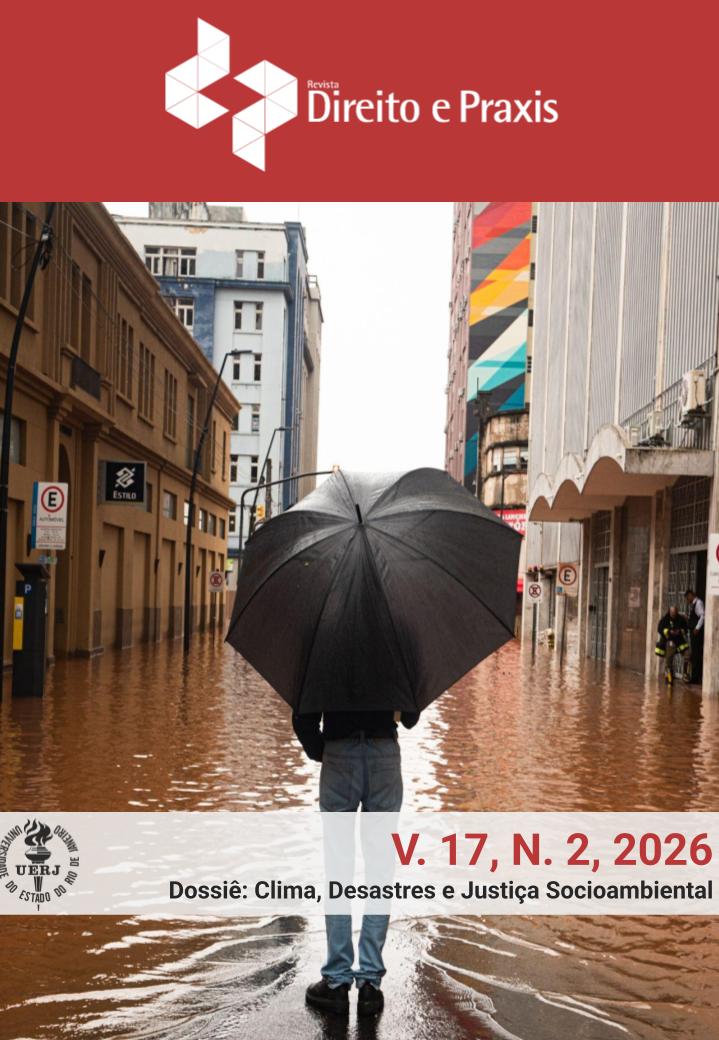
Climate disasters in Brazil are not merely natural events but the outcome of political choices and development models that racialize territory and distribute environmental risks in profoundly unequal ways. When the waters rise, they expose a structural pattern of human rights violations manifested in the systematic denial of the rights to housing, to the city, to territory, to dignified life, and to self-determination. Black, peripheral, Indigenous, and traditional communities are disproportionately exposed to climate impacts, revealing how structural racism shapes who is protected by public policies and who is historically left behind. In this context, climate policy, territorial defense, and the human rights agenda cannot be addressed as separate domains. Rather, they constitute interconnected dimensions of a broader strategy for climate justice. Addressing the climate crisis in Brazil therefore requires confronting the racialized production of vulnerability through measures that promote reparative justice, redistribute power, and place territories and their communities at the center of the formulation, implementation, and monitoring of climate responses.
Downloads
Published
How to Cite
Issue
Section
License
Copyright (c) 2026 Carmynie Barros e Xavier, Diogo Rosa Souza (Autor/a)

This work is licensed under a Creative Commons Attribution 4.0 International License.
The authors the sole responsibility for their texts.
It is allowed the total or partial reproduction of the articles of the Journal Law and Praxis, if the author is mentioned.
This work is licensed under a Creative Commons Attribution-Noncommercial-Share Alike 4.0 Unported License.
This license allows you to copy and redistribute the material in any medium or format for any purpose, even commercial, provided the original authorship is cited.
This work is licensed under a Creative Commons Attribution 4.0 International License.


