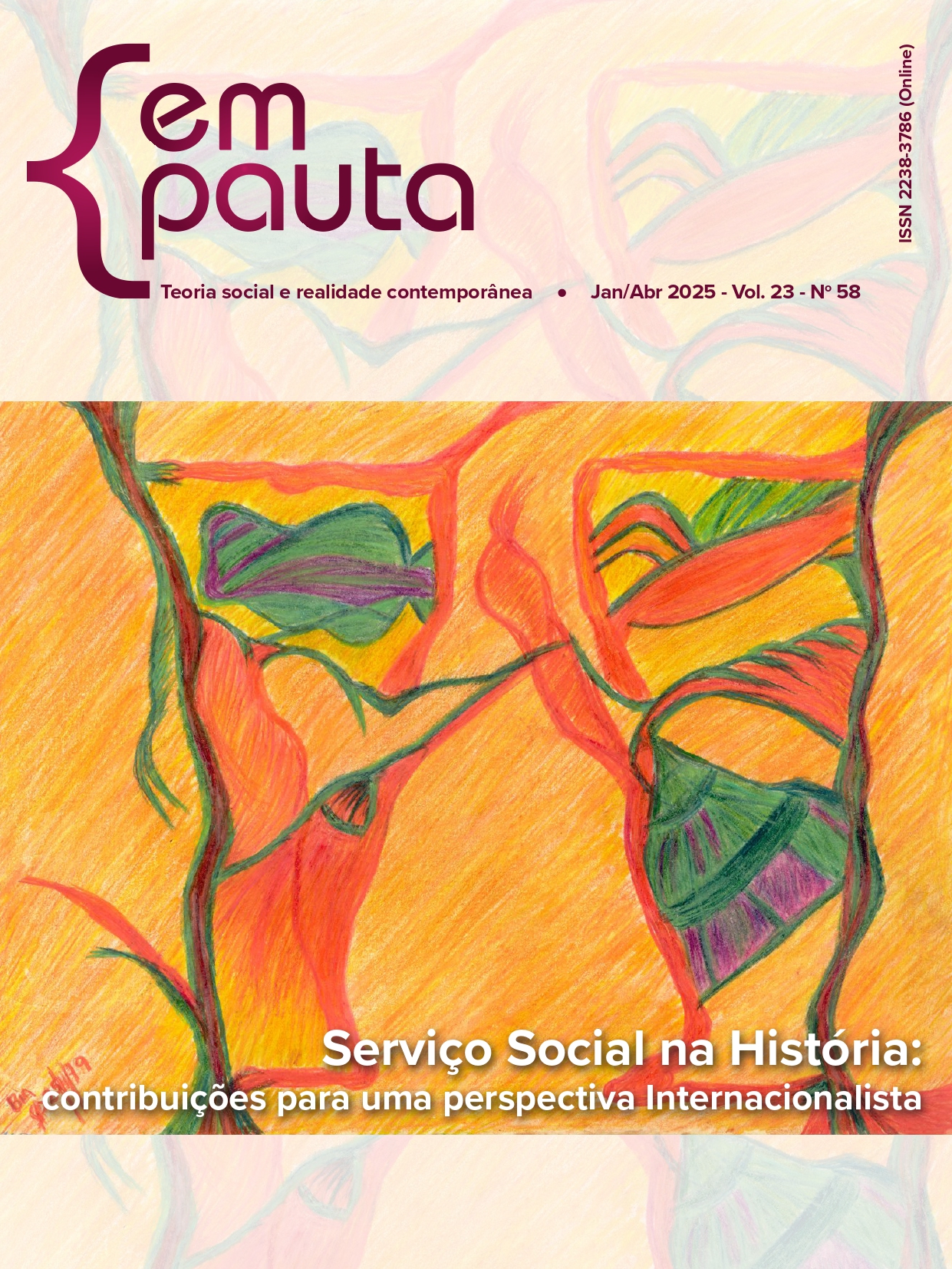
Historical considerations on the Portuguese social formation and Social Work
DOI:
https://doi.org/10.12957/rep.2025.89042Keywords:
Colonial Empire, Salazarist New State, Social Work, Catholic ChurchAbstract
This article as a critical essay aims to present some particularities that constitute the economic and social formation of Portugal, in order to contribute to a broader understanding of how Social Work emerged and became institutionalized. We highlight the fact that it was a Colonial Empire for more than four centuries; the entry into industrial capitalism forging a semi-peripheral and dependent condition; the anticlerical republicanism that shaped the First Republic; the fascist Estado Novo that sought to respond to the sum of capitalist crises; as well as the structuring role of the institution Catholic Church in the long historical duration and its unique function within the organizations of Salazarist corporatism. In this sense, we seek to signal how Social Work was hegemonically protected by the interests of the Church and Salazarism, developing a specific role within “social action” in Portugal, as well as in “social policies” in the colonies, highlighting the importance of women in the ideological construction of the regime.
Downloads
Published
How to Cite
Issue
Section
License
Os Direitos Autorais dos artigos publicados na Revista Em Pauta: teoria social e realidade contemporânea pertencem ao(s) seu(s) respectivo(s) autor(es), com os direitos de primeira publicação cedidos à Em Pauta, com o trabalho simultaneamente licenciado sob uma Licença Creative Commons Atribuição 4.0 Internacional, a qual permite o compartilhamento do trabalho com reconhecimento da autoria e publicação inicial nesta revista.
O(s) autor(es) tem/têm autorização para assumir contratos adicionais separadamente, para distribuição não-exclusiva da versão do trabalho publicada nesta revista (ex.: publicar em repositório institucional ou como capítulo de livro), com reconhecimento de autoria e publicação inicial nesta revista.
Autores têm permissão e são estimulados a publicar e distribuir seu trabalho online (ex.: em repositórios institucionais ou na sua página pessoal) a qualquer ponto antes ou durante o processo editorial, já que isso pode gerar alterações produtivas, bem como aumentar o impacto e a citação do trabalho publicado.

A Revista Em Pauta: Teoria Social e Realidade Contemporânea está licenciada com uma Licença Creative Commons Atribuição 4.0 Internacional.

A Revista Em Pauta está cadastrada no Diretório de Políticas de Acesso Aberto das Revistas Científicas Brasileiras (DIADORIM), com selo Verde.

