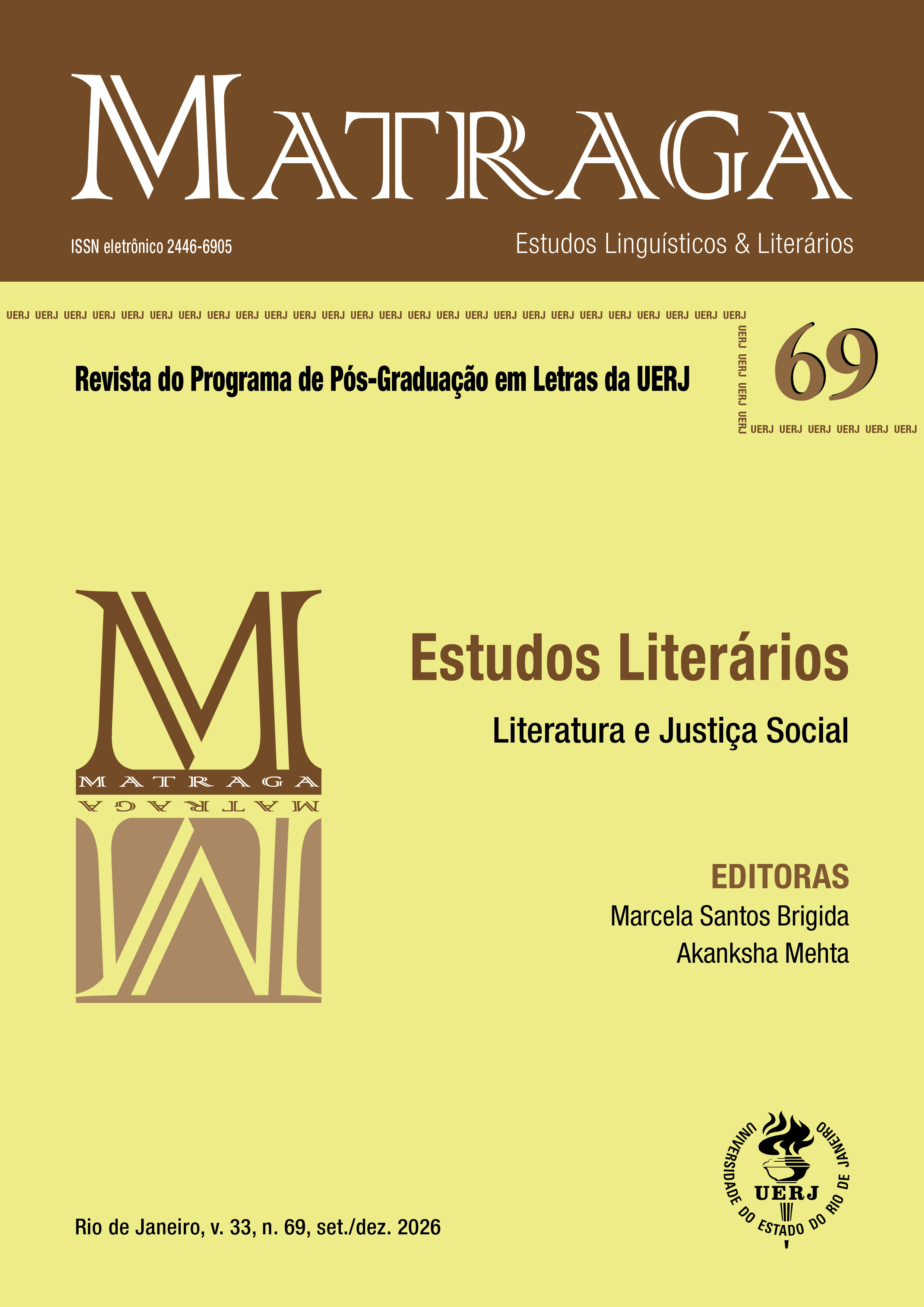
“Nature” According to Emily Dickinson: Seeking Alternative Meanings to Mitigate the Climate Crisis
DOI:
https://doi.org/10.12957/matraga.2026.96111Keywords:
Ecocriticism, Emily Dickinson, Nature, Climate CrisisAbstract
The climate crisis provoked by human action has global warming as its main cause, due to high emissions of greenhouse gases and the degradation of the environment in the name of progress. As a result, heat waves, hurricanes, floods, wildfires, among other disasters, are becoming more common and will likely be part of our routine in the future. Believing that literary studies can and should take action to mitigate the crisis, this paper proposes an ecocritical reading of two poems by Emily Dickinson that address “nature”: “Nature – the Gentlest Mother is,” (Fr741), enhanced by Krenak’s (2019) views of nature, and “‘Nature’ is what We see –” (Fr721), accompanied by Murphy’s (2019) PAN and DIM theory. The poems allow us to challenge the assumption that nature is a gentle and dedicated mother, and accept that everything about nature will never be known, thus providing alternative meanings to this once-believed stable term. Following Martin Puchner’s (2022) ecocritical proposal, this paper understands that re-reading older texts can lead us to understand “nature” in multiple ways and thus change our life practices that contribute to the climate crisis and encourage us to take action.
Downloads
References
BATE, Jonathan. Introduction. In: BATE, Jonathan. Romantic Ecology: Wordsworth and the Environmental Tradition. London: Routledge, 1991, p. 1-11.
GERHARDT, Christine. Introduction. In: GERHARDT, Christine. A Place for Humility: Whitman, Dickin-son, and the Natural World. Iowa City: University of Iowa Press, 2014, p. 1-24.
HOGUE, Cynthia. How(e) to Read Dickinson (W)riting Nature. The Emily Dickinson Journal, v. 14, n. 2, 2005, p. 60-69. Available at: https://doi.org/10.1353/edj.2006.0009. Accessed on: August 18, 2023.
HOWE, Susan. My Emily Dickinson. Berkeley: North Atlantic Books, 1985.
KRENAK, Ailton. Ideias para Adiar o Fim do Mundo. São Paulo: Companhia das Letras, 2019.
MILLER, Cristanne. Reading in Time: Emily Dickinson in the Nineteenth Century. Amherst: University of Massachusetts Press, 2012.
MURPHY, Patrick D. Challenges to developing a long-term environmental perspective: PAN and DIM. In: SLOVIC, Scott; RANGARAJAN, Swarnalatha; SARVESWARAN, Vidya (Eds.). Routledge Handbook of Ecocriticism and Environmental Communication. London: Routledge, 2019, p. 167-176.
PACHECO, Priscila. Janeiro de 2025 foi o mais quente já registrado. Observatório do Clima, February 06, 2025. Available at: https://www.oc.eco.br/janeiro-de-2025-foi-o-mais-quente-ja-registrado/. Accessed on: December 03, 2025.
PUCHNER, Martin. Literature for a Changing Planet. Princeton: Princeton University Press, 2022.
SLOVIC, Scott. Environmental Vulnerability and Literary Imagination. In: International Conference of Li-terature and Environment, 6, 2023, Rio de Janeiro. Available at: https://www.even3.com.br/vi-congresso-internacional-de-literatura-e-ecocritica-319215/. Accessed on: May 03, 2026.
THUNBERG, Greta. To solve this problem, we need to understand it. In: THUNBERG, Greta (Creator). The Climate Book: the facts and the solutions. New York: Penguin Random House LLC, 2022, p. 2-5.
WORDSWORTH, William. (1802) Preface. In: STAFFORD, Fiona. Lyrical Ballads: 1798 and 1802. Oxford: Oxford University Press, 2013, p. 94-115.
Downloads
Published
How to Cite
Issue
Section
License

This work is licensed under a Creative Commons Attribution-NonCommercial 4.0 International License.
Authorization
Matraga – Scientific Journal of the Post-graduate Program in Arts and Humanities of UERJ is authorized to publish the article submitted here, if it is accepted for online publication. It is attested that the contribution is original, that it is not being submitted to another publisher for publication, and that this statement is the expression of truth.
The works published in Matraga's virtual space – Scientific Journal of the Post-graduate Program in Arts and Humanities of UERJ will be automatically transferred, and your copyright is reserved to Matraga. Its reproduction, in whole or in part, is conditional on the citation of the authors and the data of the publication.

Matraga uses license Creative Commons - Attribution-Non-Commercial 4.0 International.