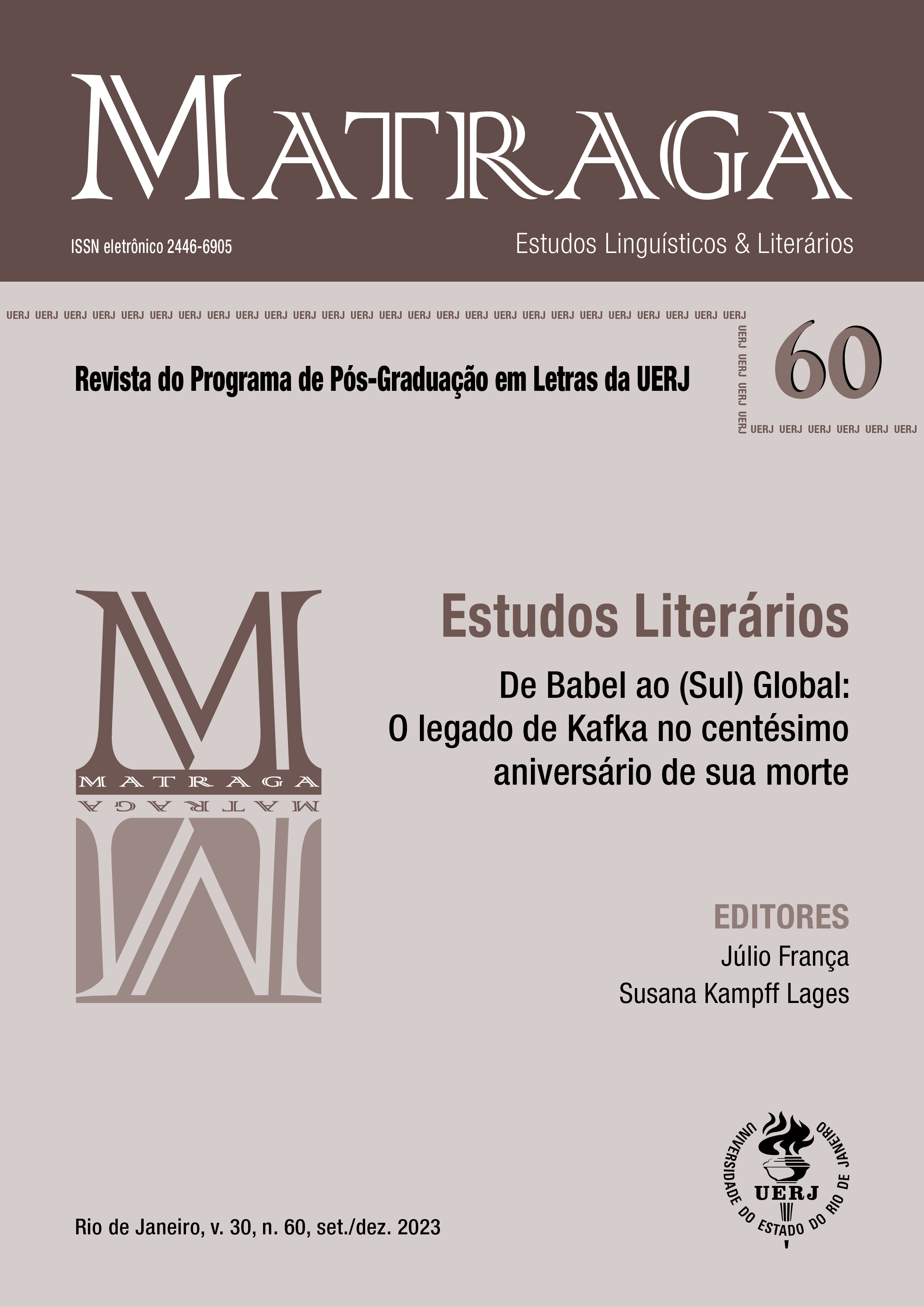
Notas sobre O castelo de Franz Kafka: temporalidade subjuntiva e comunidade
DOI:
https://doi.org/10.12957/matraga.2023.73461Palavras-chave:
Modernidade, Teoria literária, Temporalidade, Franz KafkaResumo
O ensaio parte de uma análise formal da temporalidade kafkiana em O castelo, mostrando como seu uso acentuado do modo subjuntivo, entre outras estratégias narrativas, ajuda a produzir o efeito insólito característico do romance. A narração em terceira pessoa, mas colada à experiência de K., descreve acontecimentos do enredo para em seguida colocá-los em dúvida, a partir de hipóteses e suposições hiperinterpretadas a partir do ponto de vista de um estranho àquela comunidade. Os fatos se esfarelam diante daquele que busca uma confirmação formal do direito de permanecer. Assim, representando e exagerando até o absurdo características marcantes da temporalidade moderna, Kafka consegue produzir um foco narrativo original que descreve a posição de insegurança, ontológica e metafísica, de figuras históricas afetadas pelas grandes guerras, como os refugiados e os imigrantes, que o protagonista K. de certa forma encarna.
Downloads
Referências
ADORNO, Theodor. Anotações sobre Kafka. In: Prismas: crítica cultural e sociedade. Tradução por Augustin Wernet e Jorge de Almeida. São Paulo, Ática, 1998, p. 239- 270.
ANDERSON, Benedict. Comunidades imaginadas: reflexões sobre a origem e a difusão do nacionalismo. São Paulo: Companhia das Letras, 2008.
ANDRINGA, Els. „Kafkas Konjunktiv in der Übersetzung“. In: Kafka Kring. Disponível em: . Acesso em: 14 de jun. 2023.
BUTLER, Judith. “A quem pertence Kafka?”. Terceira Margem (online). Tradução por Tomaz Amorim Iza¬bel. Ano XVII, n. 28, jul.-dez. de 2013. Disponível em: <https://revistas.ufrj.br/index.php/tm/article/down¬load/10767/7937>. Acesso em: 14 fev. 2023.
CARONE, Modesto. “O Fausto do século 20”. In: KAFKA, Franz. O castelo. São Paulo: Companhia das Letras, 2001, p. 353–361..
CÚRCIO, Verônica Ribas. Repetições de Kafka: uma análise estatística. In: Texto Digital, Florianópolis, V. 3, N. 1, abril 2007. Disponível em: <https://periodicos.ufsc.br/index.php/textodigital/article/view/1394>. Aces¬so em: 16 mai. 2018.
GRAY, Richard T. (Org.). A Franz Kafka encyclopedia. Westport: Greenwood Press, 2005.
HELLER, Erich. “The World of Franz Kafka”. In: The Disinherited Mind: Essays in Modern German Litera¬ture and Thought. New York, Harcourt Brace Jovanovich: Harvest Book, 1975.
HELLER, Erich; BEUG, Joachim (Org.). “Gespräch mit Max Brod [nach 1922]”. In: Dichter über ihre Dichtungen. Franz Kafka. München: Ernst Heimeran Verlag, 1969.
KAFKA, Franz. Narrativas do espólio. Tradução por Modesto Carone. São Paulo: Companhia das Letras, 2002a.
KAFKA, Franz. Das Ehepaar und andere Schriften aus dem Nachlaß. 2.ed. Frankfurt a.M.: Fischer, 2002b. Vol. 8.
KAFKA, Franz. O castelo. Tradução por Modesto Carone. São Paulo: Companhia das Letras, 2000.
KAFKA, Franz. Romane und Erzählungen. Köln, Parkland, 1998.
MIRANDA, Orlando de. Para ler Ferdinand Tönnies. São Paulo: Edusp, 1995.
ROSENFELD, Anatol. Kafka e kafkianos. In: Texto e Contexto. São Paulo: Perspectiva, 1976, p.225-262.
Downloads
Publicado
Como Citar
Edição
Seção
Licença

Este trabalho está licenciado sob uma licença Creative Commons Attribution-NonCommercial 4.0 International License.
AUTORIZAÇÃO
A Matraga – Revista do Programa de Pós-Graduação em Letras da UERJ está autorizada a publicar o artigo ora submetido, caso seja aceito para publicação online. Fica atestado que a contribuição é original, que não está sendo submetida a outro editor para publicação, e que a presente declaração é a expressão da verdade.
Os trabalhos publicados no espaço virtual da Matraga – Revista do Programa de Pós-Graduação em Letras da UERJ serão automaticamente cedidos, ficando os seus direitos autorais reservados à Matraga. Sua reprodução, total ou parcial, é condicionada à citação dos autores e dos dados da publicação.

A Matraga utiliza uma Licença Creative Commons - Atribuição-NãoComercial 4.0 Internacional.